
The Most Important Steam Cleaner Features
Vapor Steam Cleaners Explained
Contributor: Randy Zielsdorf
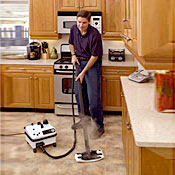
1. How does the steam cleaner system produce steam vapor – by way of a high-pressure boiler or just an enclosed chamber like an iron?
Only a boiler will give you sufficient heat and a true dry steam vapor.
2. Does it matter whether the boiler on a steam cleaner is made from stainless steel or aluminum?
Yes, an aluminum boiler is more susceptible to water degradation from the minerals. An aluminum boiler consists of two halves fastened together with screws over a gasket. Over time due to heating and cooling, it will likely warp and leak, affecting other components of your steam vapor system.
3. Is the boiler independently secured to the lower housing or sandwiched between the upper and lower housings?
Simply sandwiching the boiler between the upper and lower housings allows the boiler to move inside the system, particularly when it is set down hard or bumped severely. This may cause severe damage to the system.
4. Does the boiler have a drain plug mounted on the lowest point of the boiler or must you turn the system upside down to drain the boiler?
Tipping the system upside down will allow scale particles into the steam valve, causing the system to malfunction and not allow the user to be able to control the steam flow.
5. Is the boiler insulated, and if so, with what type material is it insulated?
This is very important to keep the heat in the boiler and not over-heat the interior of the system. Excessive heat can degrade the insulation on the wire creating a hazardous condition for the user. A form fitting, solid thermal insulation is best as it resists heat and moisture more effectively than loose fitting spun fiberglass types.
6. Does the system use an independent detachable steam hose for employing a variety of tools and accessories?
A. A steam supply hose which is directly wired into the base unit, can be difficult to store and damage is often reflected by a broken steam supply hose.
B. Does the hose have an electrical switch mounted on the handle to turn the steam flow “on” or “off”? Many less expensive systems use 120 volts to operate the hose switch, and doing so may subject the user to hazardous electrical shock. (Hose switches using 120-volt power are required to use a clear plastic insulating cover to help protect the user – be sure it is in place before operating the system.
7. Is the base or boiler housing splash proof?
This is a safety feature that protects the user from electrical shock should water be spilled onto the base unit when filling the system. Base units with protruding switches, dials, or any other controls, are not splash proof and require user caution when filling.
8. Is the system continuous fill or are you adding water directly to the boiler?
This is important for both safety and efficiency. It is important for the user be able to add more water, anytime, safely to a cold water reservoir and keep right on working, or be able to complete a project in a timely manner.
9. Does the system have a steam volume control?
It is important to be able to manage how much steam you are using. Controlling the steam volume allows you to get the most out of your system, from delicate work to difficult jobs with the least mess and best overall performance.
10. Does the system have self-locking tools or do you have to remember to lock the tools on?
This is a safety feature that is very important and it makes the system more convenient, easier to use.
11. Does the hose handle remain cool to the touch even during extended use?
If the steam flow is routed through the hose hand grip, the handle will become uncomfortable to hold on to, particularly on time consuming projects. Routing the steam flow so that the heat does not effect the user is an important functional consideration.
12. Where is the steam volume control located on the machine? Is it easily accessible to the user?
13. Does the system have an over pressure, safety release valve? If so, could it release steam in a dangerous direction through the filler cap? Or is the valve directed downward away from the user?
14. How long is the electrical cord?
Many systems come with an electrical cord that is far too short.
There are many other things to consider, but this will give you an educated start while considering a quality Vapor Steam Cleaning System. Choosing a steam vapor Steam Cleaner by price alone may not be the safest decision.
See our Vapor Steam Cleaners Comparison Chart
Related Posts


About The Author
