
Air Purifiers Questions
- Are air purifiers good for you?
- How Serious is the Problem You are Trying to Remedy?
- Do You Need an Air Purifier for Allergen, Virus or also Odor and Gas Control?
- Sizing Your Room and the Right Size Air Purifier
- The Size and Quality of the HEPA filter in Your Air Purifier
- Technologies Other than HEPA for Air Purifiers Worth Consideration
- Carbon or Other Types of Fill for Specialized Gas Control for Air Purifiers
- Lung Damaging Particles
- Where Are You Going to Place the Air Purifier in Your Room?
- Noise Level in Air Purifiers
- Automatic Monitoring of Pollution Levels in a Room
- Efficiency Level of your Air Purifier
- The Importance of a Prefilter for Your Air Purifier
- Filter Change Indicator Lights
- Central Air Purifiers
- Furnace Filters
- Your Air Purifier Manual
- Style and Your Air Purifier
- The Warranty and Reliability of Air Purifiers
- The Manufacturer’s Reputation
Are air purifiers good for you?
Yes, they do work, but some of them will not work as well as you might like and you should understand what you are buying. There are number of air purifiers out there in the marketplace, some of which are best sellers that have very questionable effectiveness. But if they didn’t work at all, why would Homeland Security recommend them? Or hospitals use them in infectious disease units? The government has even reimbursed people for HEPA air filters use in the past.
The problem is one of discrimination and education. How does a consumer make an educated choice? This is a subject about which our staff could give chapter and verse (and frequently do when people who telephone us!). I cannot even begin to tell you how many air cleaners we get in here to test and which do not pass the cut. During the last six months we have had machines to test which smell either of plastic and ozone (which is toxic), efficiency levels which are disgraceful, replacement filter costs which are a rip off, untruthful or misleading specifications, shoddy materials; the list goes on and on.
AllergyBuyersClub.com has garnered the reputation of being incredibly knowledgeable about air cleaning, and David Barnaby, the coauthor of this article, puts prospective products through their paces.
We have attempted to reproduce in this article, the kind of questions and advice we would give you if you phoned us. If you can absorb it all, this article tells you everything you need to know, and if you are confused, you can call us and request a product consultant or even go to our site to chat with one our product advisors.
How Serious is the Problem You are Trying to Remedy?
It is very important to determine how serious is the air quality problem you are trying to solve. If you are dealing with allergies, the more serious they are, the purer the air needs to be around you. One person with light allergies may feel fine with a cheaper quality air purifier, while somebody else with more severe allergies may find that same machine to be completely in ineffective and still be symptomatic Also, the exact nature of allergies or sensitivities is an important factor when choosing an air purifier. Different air purifiers are needed for those suffering from multiple chemical sensitivities or asthma. If a person has asthma, it is recommended they purchase an air purifier with a gas filter to control gases and odors, which can trigger an asthma attack. People with multiple chemical sensitivities can react to almost anything, so the correct choice of air purifier is extremely important, since this person could react to the material that makes up the air purifier such as glue on the HEPA filter or out gassing from plastic parts. When dealing with gas, odor, and chemical situations, the more concentrated the amount of gas contamination with perhaps a high rate of recontamination, the stronger the gas filter needed. If you wanted to control general cooking odors, you would need a basic gas filter, while cigarette and cigar smoke requires a very large and powerful gas filter.
Do You Need an Air Purifier for Allergen, Virus or also Odor and Gas Control?
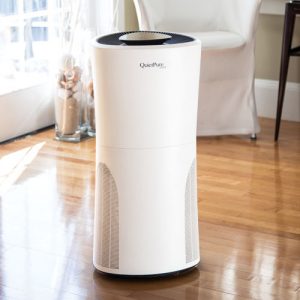
There are many choices for the consumer in the marketplace. Your choice of air purifier will be completely different according to what you are trying to achieve. For instance, if your main goal is to clear the air of allergens, you should choose an air purifier which would remove the large particulates such as pollen with a pre-filter, but also smaller allergens, which would be particulates from 0.3 to 5 microns in size. These smaller allergens include mold, bacteria, animal dander, fumes, and house dust mite allergens. A HEPA filter would trap particulates of this size and remove them from the air in your room. However, it is important to note that more than 90% of all particulates are 0.3 of a micron and smaller in size. These are known as “lung penetrating particles” and are the ones most dangerous to your health. Particulates of this smaller size, include viruses, some bacteria and germs, some house dust mite allergens, cat allergens, smoke, soot, fumes, and smog.
Since most standard HEPA filters and there do exist some HEPA filters with enhanced filtration capabilities such as IQAir and QuietPure Home Air Purifier would not be able to trap most of these smaller particles. Some machines that utilize ultraviolet light in combination or as a standard alone machine, where the rays will breakdown the DNA and RNA of the microorganism, and while not “killing”, they will sterilize those microorganisms, thus preventing them from being able to reproduce and grow. An excellent example of the this would be the air purifier. A word of caution; all ultra violet machines are not equal and their quality and effectiveness varies enormously. The most important factor determining the effectiveness of ultra violet light is whether the rays are strong enough in the first place, which is referred to as its dosage. Also, the rays need to expose the microorganism to the light for a long enough period known as “dwell time” in order for the DNA and the RNA to be altered. Furthermore, the pathogen needs to be in close proximity to the light. Even if the ultra violet light is not completely effective, having one is better than nothing, because some of the micro organisms will be sterilized by the rays because of these factors being met. Also, the idea of this technology is if the UV light does not affect the micro organism the first time through hopefully it will on the 2nd or subsequent trips.
What if I want an air purifier for odor and gas control?
If you need an air purifier primarily for odor and gas control, you would want an air purifier that will first remove the majority of the particulates in a pre-filter and then have the gases and odors removed by the gas filter. Gas molecules are very small so they cannot be removed by even the finest HEPA filter. They are 0.001 and smaller. Therefore, they need to be physically removed by a substance that will trap them in their many micro pores. A good substance commonly used is activated carbon where it is super heated and steamed resulting in millions of tiny pores. Each one of these pores will be able to adsorb the gas molecules. Once the pore cannot hold anymore of the gas molecules, it is said to be saturated, which means it will not be able to adsorb anymore gases and odors. Another method of gas and odor removal is through chemical absorption where the gas molecule will be exposed to a chemical agent where in combination with water molecule a chemical reaction will occur whereby this gas molecule will be broken down into a harmless byproduct such as carbon dioxide. A common substance used is potassium oxide, alumina oxide, and potassium permanganate. These are particularly effective at removing your lighter molecular weight gases such as formaldehyde, ammonia, and sulfur dioxide.
Good candidates for odor and gas control are the IQAir Multigas, Airpura R600 and Quietpure Home Air Purifier.
Sizing Your Room and the Right Size Air Purifier
The size of the room is a significant factor when choosing an air purifier because in order to properly clean the air in a room, you will need to exchange the air in the room several times each hour. The reason for this is that initially the air will have a certain pollution level depending on your external environment and activity inside the area you are planning to clean and maintain. In the beginning the air changes will be necessary to reduce the pollution level until it is reduced by around 80%. After this the continuation of the air purifier will be to maintain the cleanliness of the air. The more efficient an air purifier is with each pass the less air changes that will be needed to clean and maintain the air quality. Factors affecting how much you will need to clean the room would be the construction of the room as far as how much infiltration of pollution would be allowed to enter the room each hour. Also, how much activity is there in the room as far as doors opening and closing, people walking around, etc. This activity will stir up all the dust and particulates that has settled on the floors, furniture, and walls. Normally, you will look for a range of 2 to 8 air exchanges an hour with 2 air exchanges only being acceptable with the most efficient of the HEPA air purifiers. When cleaning the air for gases, odors, and chemicals it will be better to run the air purifier at a lower speed so the gas molecules will have more contact time with the activated carbon. This would also be true for units utilizing UV light to sterilize the particulates.
The Size and Quality of the HEPA filter in your Air Purifier.
The more square feet of HEPA filter media there is in an air purifier, the more particulates it will be able to remove from the air before it becomes clogged. The air purifier will be able to remove more particulates with each pass. The quality of the HEPA filter is very important both in the material used and the design. The pleats of a HEPA filter need to be uniform so each one has the same efficiency of filtration. If the pleats are too close together they can restrict the air movement too much resulting in a loss of airflow. Some HEPA filters out there use synthetic materials and not paper. Thin paper is the best material because it will be both effective at removing the highest percentage of the microscopic particulates while not restricting airflow too much. However, the better grades of HEPA filters are extremely delicate and can be easily damaged. This is why the better air purifier companies will house the filter in such a way as to protect the actual HEPA filter material.
Good candidates here are the IQAir HealthPro, Airpura, and QuietPure air purifiers.
Technologies Other than HEPA Filters for Air Purifiers Worth Consideration
HEPA filters are an example of mechanical filtration. The advantage to this filtration method is there is no reduction in its efficiency at removing the particulates from the air over time. In fact, a HEPA filter will become more efficient as it collects more particulates, because it is so fine. The only reason you need to eventually change it is because it will start to effect the airflow through the air purifier, which will result in a loss of air cleaning capacity and also may damage the motor because of the heat that may buildup. The disadvantage to this kind of filtration is that these air purifiers tend to be noisy, especially on the higher speeds. Their filters are replaceable and can be rather expensive, especially on the more efficient air purifiers which remove more from the air over a shorter period of time.
The other types of air purifiers are called electronic air purifiers and they utilize a single or combination of technologies to clean the air in a room. An electronic air purifier works by charging the particulates upon entering the machine by an ionizer. This is a wiring mechanism that creates an electrical charge; with the outcome being the particulates are negatively charged.
There are five different forms of electronic air cleaning:
- Electrostatic precipitator, which consists of a series of metal collection plates that are oppositely charged to the ionized particles. Therefore, the particles will be attracted to these metal plates like a magnet with the net result being the ability to collect particles as small as 0.1 of a micron. There is a drawback to this type of air purifier, which is as the collection plates collect the particles, and their surface area becomes covered by the particulates, their ability to attract the particles will decrease until the plates are taken out and cleaned. In a good unit you may start out at an efficiency of 80% and degrade down to as little as 20%. Thus, it is imperative you clean the metal collection plates on a regular basis as frequently as daily to weekly. These types of air purifiers will generate a fair amount of ozone definitely enough for you to smell and may be annoying to some people. Pros: electrostatic precipitators have no expensive filters to replace and they are quieter than HEPA filters. Cons: ozone is emitted though most of these machines generate safe levels and there is a steady reduction in efficiency as the metal plates become dirty regular cleaning is imperative.
- Media charged filter, uses an electrostatic filter that will collect the particles by being oppositely charged to the ionized particles and therefore able to collect particles again as small as 0.1 of a micron. This filter will start out at a high efficiency as much as 80 to 90 percent but will decrease as the surface area of the filter becomes clogged with particulates. The biggest decrease will be in the smaller particles, because remember this is not a HEPA filter and it is not able to mechanically remove the microscopic particles, because it is not as fine and thick a filter. It will however maintain its ability to filter out the larger particulates better than the electrostatic precipitator because its filter media is small enough to collect the larger particles without having to rely on the opposite charging attraction needed for the smaller particulates. However, you will still have a decrease in the efficiency to as low as 50% if the filter needs replacing and it is not changed. Pros: they are quiet and clean a large amount of air. Cons: are the cost of the replacement filters and there will be a gradual efficiency drop as the filter becomes dirty.
- Negative ionizer, cleans the air by charging particulates. The particles are not removed from the room just from the air. The way it works is the particles are drawn into the machine where they are ionized and negatively charged. From there they are sent back into the room where they are attracted to the positively charged walls, furniture, positive and neutrally charged particulates where they collide with them until they are heavy enough to fall to the floor. The result is that the air becomes free of particulates and the particle count is reduced. The drawback to this type of air purifier is that all of your particles land up on the floor, walls, and furniture. As the particles lose their charge they will release themselves from the walls falling back into the air. Also, unless you are regularly vacuuming and dusting, the particles will be kicked back into the air when any air movement occurs by a door being opened or someone walking in the room. A major concern is that if an ionized particle is inhaled, it is more likely to stick to the walls of your respiratory system thus increasing the chance of an allergic reaction. The advantage of these kinds of air purifiers is that they will be quiet because there is no resistance to air flow and there are no filters. Also the tendency will be to use them for treating a large amount of air, because if a smaller, quieter fan is used, it will still result in a large amount of air being circulated through the machine. Also, there are no expensive filters to replace such as with HEPA filters and no pre-filters that need to be cleaned. Still, we tend not to recommend negative ionizers except if they are used in conjunction with other air cleaner technology. Pros: They will be quiet and there is no filters to clean or change. Cons: the particles are not actually removed from the room, and can work themselves back into the air, thus re-polluting the room caused by movement such as a door opening and closing or people moving about. Also they create a good amount of ozone, so the odor and human reaction either to the odor or toxicity needs to be addressed.
- Ozone machines are definitely the most controversial and the whole premise is based on the use of ozone to clean the air but its claims are very suspect. The ozone machine manufacturers claim the air is cleaned and the gases, chemicals, and odors are removed from the air. However, the ozone reacts with the chemical and it breaks it down into another form of pollutant. The question is whether this new form of pollutant is even worse than the original chemicals. Also, to be effective, it must emit high levels of ozone which have been determined to be detrimental to the respiratory system. Therefore, you have a dilemma with this machine, which is to run it at safe low levels and have little effect, or on high levels, where the concentrations could be dangerous to humans. In addition, the question of particulates in the air is not even addressed, since there are no filters to trap the particles. You may be familiar with their use in the hotels where to prepare a room for a customer, the machine is put in place and the machine turned on high. The windows and doors are closed and the room is left unoccupied while the machine is in operation, which is usually to remove the smoke odors. Once the room is cleaned hotel staff will go into the room, turn off the machine, and open the windows to air the room out and rid the room of the ozone. Pros: Great for smoke odor removal after smoking or a fire. Also very effective for the price. Cons: Ozone is a concern to human health and this has been well documented by the EPA. They can be dangerous and their air cleaning ability is suspect.

Airfree Onix 3000 Air Sterilizer - AirFree Sterilizer incinerate particulates in high heat at 400 to 600 degrees. It is effective at removing airborne particulates of size 1 micron and smaller. This would include germs, bacteria, mold, viruses, pet dander, smoke, and house dust mite allergens. Keep in mind, this is not something you would want to use to remove dusts, pollens, and other larger particulates. It does not use a fan, so is not able to circulate the air in a room and to clean the air quickly. The Airfree sterilizer works by slowly over a 1- 3 week period removing the airborne bacteria, viruses, molds, etc. as stated above and it continued operation will maintain the sterilized environment. It is therefore an ideal machine for virus and spore elimination. Its most effective use is to prevent mold from reoccurring in the future. Each unit will sterilize an area of 250 square feet with an average ceiling height of 8 feet so it will control an area of 2000 cubic feet. One of the three things necessary for mold to grow is the presence of air born mold spores. Normally, there will always be an abundance of these because they are in great supply in the outdoors and some of them will always circulate into the inside of your house. However, the use of the Air free Sterilizer will eliminate them so mold formation will become very difficult.The heated sterilization process used by the Airfree Sterilizer is intriguing, and backed up by an unusual number or laboratory studies as to its effectiveness. Particularly interesting about this technology is the measurement of the residual level of contaminants in a room after the testing period which can be as low as 85% reduction from its original levels which has exceeded our results in testing of HEPA filters. Pros: Great against a variety of tiny airborne particulates like mold, germs, bacteria, and smoke, to name a few. Cons: It is slow acting and takes time to remove sterilize the air. It is also not as effective against traditional allergens, like dust or pollen
There are also air purifiers that use a combination of a pre-filter to collect the large particulates, and a UV light. These air purifiers will emit ozone into the room, which reacts with the gases and odors in the room and chemically breaks them down into another form.

After looking at all the technologies, we are definitely fans of media charged filters such as Blueair, which uses the ionizer to charge the incoming particulates so the particulates will be attracted to the electrostatic filters. There is no ozone emitted by this air purifier. We also like Air Sterilizers for both how effective they are and for the large amount of contaminants they remove.
Carbon or Other Types of Fill for Specialized Gas Control for Air Purifiers

There are many different types of carbon available to be used in gas filters ranging from coal based to coconut shell. The main purpose of carbon filters is to physically adsorb the gas molecules into their pores. Activated carbon filters will be best at removing the VOCs and SVOCs, which are of a higher molecular weight. However, carbon filters will not be very effective in humid conditions where the air contains a large amount of water molecules. Carbon is also not effective in removing the lower molecular weight gases from the air such as formaldehyde and sulfur and nitrogen dioxide. These require specialized gas control ingredients made up of Chemisorbers which will chemically remove these gases. What Chemisorbers react with a water molecule in the air and the gas molecule to chemically break it down into a harmless form such as carbon dioxide. This is chemical absorption. Common Chemisorbers are alumina oxide, alumina silicate, and potassium permanganate. The amount of gas filter media is important in measuring the effectiveness of a gas filter but this is not the entire story. Obviously, the more micro pores of carbon, the more gas and odor can removed and the longer the gas filter will perform before all of its pores are saturated and need to be changed.
What are just as important are the particulate filters included with the gas filter in the air purifier. If there is an inefficient pre-filter before the air encounters the gas filter, a great deal of the micro pores in the carbon will be used to collect the particulates not removed by the pre-filter. Therefore, a gas filter containing many pounds of activated carbon could prematurely become saturated. The design of the gas filter is also important as to airflow. A gas filter with fine activated carbon will cause a lot of resistance to airflow. However, if the gas filter consists of larger pellets the air will flow through the filter easier. Also, a pleated design can result in a larger surface area of carbon, which would increase the efficiency of the rate of gas removed since the gas molecules will have a better chance of being adsorbed with this larger surface area.
Excellent candidates here are IQAir HealthPro, QuietPure Home and AirPura C600.
Lung Damaging Particles
Lung damaging particles are of most concern because of the fact they are small enough to get through your sinus cavities and into your respiratory system while at the same time large enough not to be exhaled out. Therefore, it is very important when considering which air cleaner to purchase to make sure it will be able to filter all of these particulates. The size range will vary from 9 microns to 0.3 of a micron in size. This is why the HEPA filters have become so important to the air cleaning industry.
Particulates in this lung damaging size range are some bacteria, most molds, fumes, smoke, smog, diesel exhaust, cat allergens, pollen fragments, house dust mite allergens, settling dust, and suspended atmospheric dust. All of these particulates can cause an allergic reaction. Keep in mind, it is still necessary to filter out particulates smaller than these, but particulates smaller than 0.3 of a micron have a better chance of being exhaled out of your respiratory system. However, some of them will still remain in your lungs to do damage. In addition, the American Lung Association believes particulates that have been ionized have a better chance of sticking to your respiratory system so their likelihood of being exhaled is low. Therefore, an air cleaner’s ability to filter out particulates in the 0.01 to 0.3 of a micron in size is important, since this would include some bacteria, viruses, some pet dander, some house dust mite allergens, and some of your smokes and smog. An excellent example here would be the IQAir HealthPro Plus.
Where are you Going to Put the Air Purifier in your Room?
The placement in the room is important when you consider your air purifier choices. We recommend for bedrooms a quieter air purifier with less air exchanges during the night, than a family or living room where there will be more traffic and faster re-polluting of the air. Placement of the air purifier in the room will always be best if it is in the middle of the room. However, since particulates and gases will through diffusion maintain an equal distance between one another, as the particle count is reduced as the air purifier cleans, the room, the remaining particulates will spread out to maintain this equal distance. As they move across the room, they will eventually be drawn into the vacuum that is created by the air purifier’s fan. Therefore, placement of an air purifier on the sides or ends of a room will be able to filter the particles on the opposite side of the room.
Noise Level in Air Purifiers
Noise level is a personal choice because some people do not mind, or even welcome a background white noise, while some people cannot stand any fan noise whatsoever. Also, when someone is purchasing an air purifier for a bedroom, they are usually looking not only for a quiet air purifier but also a smooth running machine that will not have an inconsistent pitch and noise level. What is helpful is not to make a purchasing decision solely based on the area size a specific air purifier can clean. The reason being a unit that can clean 800 square feet will still do an excellent job in a 200 square foot room with one important additional benefit. Because of the larger capacity air purifier, you will be able to properly clean the smaller room on the low or medium speeds, which are almost always significantly quieter on the larger HEPA air purifiers. If someone purchases an air purifier that is tight in its sizing capacity they will find they need to run the unit on high most of the time, and even the smaller air purifiers are noisy on the high speed. The only reason someone should not consider a larger air purifier is because of the physical size being too large for the room.
A perfect choice for a quiet air purifier for bedroom use is the QuietPure Whisper Air Purifiers or the Blueair 203 air purifier
Automatic Monitoring of Pollution Levels in a Room
There are some air purifiers which have an infrared detector that will monitor the amount of particulates in its vision. Initially, when turning on the air purifier, it will automatically run itself on the high speed, because the particle count will usually be high. As the particles in the detector’s vision are reduced, it will turn itself down to the medium speed and eventually to the lower speed. The idea in theory is excellent but since the area being measured is so small, the accuracy of this automatic monitoring device is in reality pretty minimal. A separate particulate monitor is recommended.
The QuietPure Home Air Purifiers have this monitoring system.
Efficiency Level of your Air Purifier
Two critical things to consider when measuring how effective an air purifier is at performing, is the amount of air that it can clean each hour and what percentage of the pollution does it remove from the air that is circulating through it. This second factor is called the efficiency. For example, if the particle count per cubic foot of air going into the air purifier is 1,000,000 particles and the particle count of the air coming out after it has passed through the filters is 300, than the efficiency of the air purifier would be 99.97%. Therefore, you can see how the efficiency of the machine is important since a machine that is only 60% efficient would allow 400,000 particles to go back into the room. The efficiency is important because there are many air purifiers on the market that have a HEPA filter but their relative efficiency is undocumented. This only means that the filter has been tested to remove 99.97% of all of the particulates that are 0.3 of a micron in size or larger. However, this is when all of the particles in the air contact the HEPA filter and none of the air is able to bypass the filter itself. Once you take the HEPA filter and install it in the air purifier other variable are involved. As the air is drawn into the air purifier, some of the air can bypass the filter media depending on the way the filter is housed inside of the air purifier. As much as 40 or 50 percent of the air can pass by the filter media in some HEPA filter based air purifiers resulting in poor performance.
Our most efficient machines in our testing were the IQAir series and the Blueair Pro series.
The Importance of a Prefilter for your Air Purifier
The pre-filter is one of the most significant parts of an air purifier. Most pre-filters are designed to remove particulates 5 to 10 microns and larger. This is useful because the very large particles will be removed from the air (such as pet hair or large dust particles) which will protect the gas filter media or the HEPA filter media from becoming used up prematurely. However, you must realize that the percentage of particulates in the air that are 5 microns and larger is very small. For example, if there are 1,000,000 in the air per cubic feet, there is normally only around 400 to 800 particles that are 5 microns and larger. Therefore, much of the particulate removal is still left for the pores of the activated carbon of the gas filter, if it is the next filter in line after the pre-filter or the HEPA filter. A large gas filter with 15 pounds of activated carbon can become quickly saturated if it has no pre-filter or the pre-filter is not very efficient. Also, the HEPA filter is too expensive a filter if it is used to remove particles larger than 1 micron. The best example of a pre-filter is the one on the IQAir Healthpro which is 100% efficient at removing particulates 1 micron and larger. In addition, it is 55% efficient at removing particulates 0.3 of a micron and larger. So as you can see this filter will remove 90% of all of the particulates in the air and prolongs the life of the HEPA and gas filters.
Filter Change Indicator Lights
We find a filter change indicator light to be extremely helpful, because someone’s ability to actually see particulates in a room to judge whether a HEPA filter needs replacing, or relying on smelling odors to judge the life of the gas filter, is not an accurate or scientific way to track the life of the filters. In addition, you would need to remember to check the filters periodically to examine them. The best air purifiers will have individual filters for each of these purposes. A well-constructed air purifier will have a separate pre-filter, gas filter, HEPA filter, and post filter. It will indicate when each of these filters needs to be replaced. All of the guesswork is eliminated, and you will not be running the air purifier with filters are clogged which should be changed, or be prematurely changing filters, which is unnecessarily expensive.
IQAir, Blueair and QuietPure Air Purifiers have change filter indicator lights.
Ease Of Changing Filters
This is something that is often overlooked and can prove very frustrating to the owner of an air purifier. The best air purifiers are those requiring no tools to replace the filters. Those units where you simply pop out a door, pull the filter to be replaced out and replace it with the new filter are by far the easiest. Some air purifiers require some considerable disassembly, requiring tools; some are manifestly more difficult than others. If it is tedious and difficult to change the filters, the average person will put off changing them way beyond their optimal change dates. Also, just because some manufacturers say their pre-filters do not have to be replaced but can be periodically vacuumed or washed is a bit deceptive as the process of accessing the pre-filter is very tedious and ignored my most people.
The easiest filters on an air purifier to change are the Blueair and QuietPure Air Purifiers. The IQAir is quite easy too when you have done it once.
Weight and Mobility of Your Air Purifier
Most air purifiers are on casters, so you will be able to move them from room to room without having to physically lift them. However, this is not helpful if you need to carry it downstairs or upstairs. In this case, it is easier if the air purifier is lightweight. The Hamilton Beach Series are the easiest just to pick up and carry to the next room.
Upkeep Costs for an Air Purifier
This is another factor which is often overlooked by the potential purchaser of an air purifier. An air purifier that costs $400 to $500 can end up costing from as little as $50 a year to maintain or as much as $200 a year. You need figure out how often the filters need to be changed and how much they cost. Some air purifiers may have expensive filters, but you may be able to go a longer period of time before they will require changing. You should be aware that the quoted filter change intervals because can vary significantly depending on how often the unit is run and the pollution level of its environment. For example, the Austin Air manufacturer states you can go five years between filter changes. However, we have found the norm is more like three years for all machines, given the real life conditions under which it is used. It is also helpful if the unit has individual filters to change as opposed to one big expensive combined filter to change. The reason why a combination filter (HEPA plus carbon) is a disadvantage is because when the HEPA filter and the carbon gas filter are combined, both filters rarely will require changing at the same time. Most of the time, the gas filter will need changing before the HEPA filter. However, if either side of a combo filter needs to be changed, you are forced into replacing the entire filter, which is an unnecessary expense.
Air Purifiers, Ozone Emissions and Outgassing
Any ozone emission, which is a toxic substance, is not desirable regardless of whether the person has allergies, asthma, or multiple chemical sensitivities. However, the effects are usually worse for these people. In general, ozone is an irritant to the respiratory system. It becomes progressively irritating as concentration levels increase. The problem is that most manufacturers do not monitor the ozone levels. Outgassing, which can occur from the silicone used for the gaskets and glues used to attach the filter media to the housing, can outgas and cause a reaction, especially for people with multiple chemical sensitivities. If you belong in this category you should look for an air purifier where the pre-filter and HEPA filter come before the gas filter, so any out gassing that could otherwise occur will be removed by the activated carbon. Keep in mind, it is recommended anyway that there be some type of filter after the carbon gas filter, to remove any carbon particles that may fall off as the air passes through it.
A good air cleaner for those with multiple chemical sensitivities is the Airpura series.
Central Air Cleaners
Central air cleaners will allow a person to clean all of the air in their house with one unit. You should only consider this type of air cleaner if you have a central heating, cooling, or both that circulate air throughout the house. The way a central air cleaner works is that it is tied in with the existing central air system in the home. The central air system will circulate the air back into the rooms of the house through the ductwork and out the supply registers and the air will return back to the system through the return ductwork. A central air cleaner is installed by having the return air drawn into the intake of the air cleaner and the cleaned air then is circulated back into the central air main return. It is recommended to intercept the air at the end of the main return just before it goes into the furnace or air conditioner. The installation consists of two openings in the main return at least 6 feet apart to prevent shortcutting. Ducting is run from the first opening to the intake of the air cleaner and then from the outflow of the air cleaner back to the second opening. The airflow of the air cleaner is only to draw the air from the main system to clean it and not to circulate the air throughout the house. It is for this reason the central air system needs to be running while the air cleaner is running. A central air cleaner is not strong enough by itself to push the air through the HVAC system and out to the rooms of the house and then back into the system. We recommend setting the HVAC system with the fan on, so the air will circulate regardless of the temperature setting.
Keep in mind, a central air cleaner will be able to filter out most of the particulates and remove most of your gases and odors but it will never be as efficient as a free standing air cleaner in a specific room exchanging the air several times an hour. While the central air cleaner will exchange the air in the house 2 to 4 times an hour because of all the registers and duct work in the home 90% and better efficiency is difficult. The big advantage is if you have a 2000 to 4000 square foot home, you will be able to clean the air with one air cleaner as oppose to several units and it will be quiet.
Furnace Filters
An efficient filter in your heating or cooling system can reduce your particulate levels and hence air pollution by up to 50%. As long as your central air system is operating, all of the air will circulate through this filter, so not only will you be protecting your furnace and air conditioner, but the incoming pollution will be reduced. These filters are electrostatic so the flow of air creates a charge where the particulates are drawn toward the filter. The particles are not charged like an ionizer. Some of these filters are not replaceable and require periodic cleaning every 1 to 4 months while some are replaced every 1 to 4 months. Keep in mind, these filters will do nothing to remove gases and odors. They are only for the removal of particulates. In addition, they do not to replace an air cleaner, because even the best filters will only remove particulates down to 1 to 1.5 microns in size. In order to remove smaller particulates you would need a HEPA filter and the resistance of such a filter would restrict the movement of air in the HVAC system and cause problems.
Your Air Purifier Manual
Instruction and information from the manufacturer is extremely helpful. In addition, you want to be sure you can contact the dealer for after sales support after you have purchased the air purifier. They should be able to work with you, as a liaison between you and the manufacturer. A good manual will explain the filters in the air purifier, how to set the unit up if there is any assembly required, offers troubleshooting advice, and gives you maintenance information. A poorly written owner’s manual can be very frustrating if you have any questions or basic troubleshooting situations.
Style and Your Air Purifier
The choice of style of the air purifier is a personal choice. Usually, if the air purifier is going to be set up in a visible room such as the living room or the family room the looks of the unit will be important. Color will also be of importance. This will be less important if the unit is being purchased for a less widely used room such as a basement. For some, style will not be as important as its level of effectiveness, but for others, the styling is almost as important as choosing a sofa for their living room or family room. Some people do not want it to stick out, but blend in with the styling of the room. Keep in mind, the design of the inside of the air purifier is more important. The looks are strictly cosmetic. The exceptions would be the intake and the outflow areas. You do not want the inflow and the outflow areas near each other because you will have shortcutting, which is where some of the air that has just been cleaned may be drawn back into the inflow of the air purifier. Also, you want the air to be sent back into the room in multi directions and in a larger area. It is better for the air to be circulated back into the room in more than one direction. Also, if the air comes out of one small opening, it can be very uncomfortable if a person is sitting close to it. The better designs are where the air is drawn into the air purifier through the bottom in all directions and outflows at the top in all directions from the entire perimeter of the unit.
A good looking unit is the Blueair and wins our beauty pageant award. Good multidirectional clean air systems are the Blueair and IQAir air purifiers.
The Warranty and Reliability of Air Purifiers
This is an area that most consumers concentrate on and is very important. The old saying that you get what you pay for is often true. If you buy a product that is inexpensive with a short warranty, often you will find yourself replacing the unit. You may realize later on you would have been better purchasing a more expensive air purifier but one which was better built, with the longer warranty. The best warranties are those offering five years on the main fan and motor parts. A reliable air purifier should have no problems with the motor, fan, and electrical components and controls. The rest of the air purifier consists of the filters, which need periodically cleaning or replacement. Quality control is important and any information you can glean about the reliability and breakdown rates of air cleaners is recommended.
The Manufacturer’s Reputation
Reputation of the manufacturer is important. Chances are if previous customers are unhappy, and there is published information of a product’s past performance, you are also going to have problems. Of course, it is possible a good manufacturer may go through a bad period on a particular product, which is not reflective of the company in general, or where the manufacturer has taken customer feedback to heart and has acted upon to prevent repetitive problems in the future
Summary
In summary, the most complete air cleaning system, assuming one has a central air system in their home, would be an efficient furnace filter along with a central air cleaner. In addition, a free standing portable air cleaner in the bedroom and most frequently occupied rooms of the house would complete the air cleaning system. If you do not have a central air system in your home, you want enough air cleaning to attain a minimum of 2 air exchanges with the most efficient of HEPA air cleaners to as many as 4 to 8 air exchanges with other types of air cleaners.


