
Air Purifier Report – Test Results of AllerAir 6000 with UV
Air Purifier Reports – Aller Air Purifiers
Contributors: David Barny aand Bob Cobe
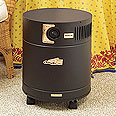
The top of the air purifier unit can be removed by undoing 4 Philip screws. They were rather tight but once removed the top came off easily. There will normally be no need to remove this cover except to service the fan or repair any electrical problem.
In order to access the filters on the unit all work is done from the bottom of the unit.
The air purifier consists of a pre-filter, gas filter, gas filter wrap, HEPA filter, and a UV light.
1. Pre-filter
Very easy access requires no screws to be undone. Simply turning the air purifier upside down will allow you to pull the filter out to vacuum and clean. It is a typical cotton and polyester material filter that will only remove particles 5 microns and larger. The filter is located inside of the gas filter cylinder.
2. Gas Filter
To access this filter you will need to remove the bottom lid, which consists of four Philip screws. They were very tight and once removed you needed to tap the lid with a screwdriver to loosen it. Once removed, removal of the gas filter was very easy. The gas filter had a dust filter wrap around it to keep in the dust that might occur from the carbon in the filter. The top and bottom of the gas filter has two gaskets that are very spongy and create a tight seal. We weighed the filter and it weighed 20.5 pounds so this would meet the rated 18 pounds of carbon as stated on our website, but contradicts what the manufacturer stated to us which was the 6000’s now come with 21 pounds of carbon. The air filter would probably weigh around 24.5 pounds if there were 21 pounds of carbon in it.
3. HEPA Filter
The HEPA filter is a cylinder that sits outside of the gas filter cylinder. It was very easy to remove and it had a spongy tight sealing gasket on the top and the bottom of the filter. The filter material was a good quality paper material and the pleating was done properly to increase the surface area for air filtration.
4. UV Light
In order to access the UV light you need to remove a middle shelf that sits above the filters which consists of three Philip screws. They were easy to remove and the shelf lifted right out. So, access to the UV light involved removing the bottom plate and a middle plate. The UV light was a 10-watt straight bulb and the way it was attached and the wiring appeared to be of good quality installation. We were concerned about the positioning of the UV light based on what a representative from Allerair had told us. It had been explained to us that the benefit of the UV light was to bathe the particles trapped in the HEPA filter. However, the UV light was positioned above the middle plate below the top section of the air cleaner where the fan and outflow was. From our observation, we could not see how the UV light could be exposed to any of the particulates in the HEPA filter. The only application of the UV light was to address those particles that had made it through the HEPA filter and had moved up through the sides of the middle shelf and into the area where the UV light was and from there it moved to the top and back into the room. But the manufacturer’s representative had stated that the movement of the particulates were at such a high speed as to not allow the UV light to do anything to the DNA and RNA of the particulate. In order for the UV light to break down the DNA and RNA of the particulate, you need to be close enough to the light, the light needs to be intense enough (dosage), and the exposure time needs to be adequate. He stated that the exposure time would not be close enough to provide any benefit. Therefore, the design of this air purifier appears to contradict what he stated to us.
We were not able to perform a particle count test because our laser diode particle counter needs to be recalibrated. We will perform the particle count test at a later date.
On August 16, 2002, we performed a particle count test with this air purifier and we came up with the following results:
The particles going into the Allerair were 1,341,170. We took 10 readings in the room and averaged them to get this number.
LOW SPEED: We took 10 readings and they averaged out to 102,481. Our particle count efficiency was 1- (102,481 divided by 1,341,170) = 92.36% efficiency at 0.3 microns and larger in size.
HIGH SPEED: We took 10 readings and they averaged out to 96,890. Our particle count efficiency was 1- (96,890 divided by 1,341,170) = 92.78% efficiency at 0.3 microns and larger in size.
TURBO SPEED: We took 10 readings and they averaged out to 103,640. Our particle count efficiency was 1- (103,640 divided by 1,341,170) = 92.27% efficiency at 0.3 microns and larger in size.
Overall, this is an excellent result, but we were disappointed it was not even higher results based on the fact that we felt the HEPA filter was of a good quality and the seal appeared very tight so we did not think there would be any leakage whatsoever. However, this particle count efficiency would still place it up there with the best of the machines we have tested.
In order to give you some perspective we have tested some nationally known best selling air purifiers not sold on our site and their efficiency is between 15 and 40%.
The AllerAir 6000 Vocarb -UV Air Purifier (VOC & Ultraviolet) is available at Allergybuyersclub.com
This is the kind of testing done by our staff. The AllerAir 6000 air purifier provides the highest filtration efficiency and sterilization power in the AllerAir line of air purifier products we offer.


